
Visiting an elephant sanctuary can be one of the most memorable experiences in Thailand. However, the word “sanctuary” does not automatically guarantee that a venue follows responsible animal-welfare practices.
Some facilities have stopped offering rides but continue to schedule bathing, touching, posing, or other close-contact activities. Others give elephants more freedom to forage, socialise, rest, and move away from visitors.
Therefore, choosing among the best ethical elephant sanctuaries in Thailand requires more than comparing reviews or photographs. Travellers should examine how the elephants live, what visitors are permitted to do, and whether the animals’ daily routines are organised around welfare or entertainment.
What Makes an Elephant Sanctuary Ethical?
An ethical sanctuary prioritises the elephants’ physical and psychological needs rather than creating the closest possible tourist encounter.
Although welfare practices vary between facilities, responsible sanctuaries generally share several characteristics:
- No elephant riding
- No circus-style shows or performances
- No tricks, painting, or staged behaviour
- No forced posing for photographs
- Suitable food, water, shade, and veterinary care
- Space for elephants to walk, forage, and rest
- Opportunities for appropriate social contact
- Transparent information about each elephant
- Activities designed around observation and education
- The ability for elephants to move away from visitors
The strongest indicator is choice. An elephant should not have to remain beside visitors, enter the water on command, accept continuous touching, or repeat the same interaction for several tour groups.
“Ethical sanctuary” is not a term that travellers should accept without checking how a venue actually operates. The original article correctly noted that sanctuary claims require verification rather than reliance on marketing language alone.
How Were These Elephant Sanctuaries Selected?
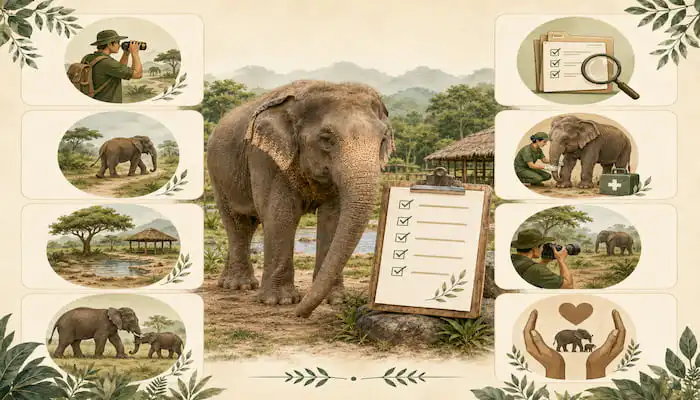
The sanctuaries in this guide were chosen because they publicly promote elephant rescue, improved welfare, observation-led tourism, or reduced-contact experiences.
This is not a permanent ranking. Elephant programmes can change, while individual activities may differ between locations, seasons, or booking packages. Travellers should always check the current programme directly before reserving a visit.
The following factors were considered:
| Welfare factor | What responsible visitors should look for |
| Visitor activities | Observation and education instead of riding, tricks, or performances |
| Elephant choice | Elephants can move away, rest, forage, or remain out of view |
| Living environment | Access to suitable space, shade, water, natural ground, and vegetation |
| Social needs | Appropriate opportunities to interact with compatible elephants |
| Transparency | Clear information about the elephants’ backgrounds and daily care |
| Health management | Experienced caregivers and access to veterinary support |
| Photography | Natural observation rather than forced posing or repeated physical contact |
| Long-term responsibility | Lifelong care rather than breeding elephants to supply tourism demand |
Visitors should examine the full experience rather than treating one feature, such as “no riding,” as proof that every practice is appropriate.
Which Ethical Elephant Sanctuaries Should You Consider in Thailand?
Responsible elephant venues can be found across Thailand, including Koh Samui, Chiang Mai, Sukhothai, Phuket, Krabi, Koh Lanta, and Kanchanaburi.
The most suitable choice will depend on your itinerary, the type of experience you prefer, and the venue’s current welfare practices.
| Sanctuary | Location | Main visitor focus | Best suited to |
| Samui Elephant Haven | Koh Samui | Rescue education and elephant care | Visitors staying on Koh Samui |
| Boon Lott’s Elephant Sanctuary | Sukhothai | Small-scale, long-term care | Travellers seeking a quieter experience |
| ChangChill | Chiang Mai | Community-based observation | Visitors exploring northern Thailand |
| Following Giants | Koh Lanta and Krabi | Forest observation | Travellers visiting Thailand’s southern coast |
| Phuket Elephant Sanctuary | Phuket | Observation of rescued elephants | Visitors staying in Phuket |
| Somboon Legacy Foundation | Kanchanaburi | Hands-off education | Travellers visiting Bangkok or western Thailand |
These venues should not be treated as interchangeable. Each has its own location, visitor format, facilities, and approach to elephant care.
Why Visit Samui Elephant Haven on Koh Samui?
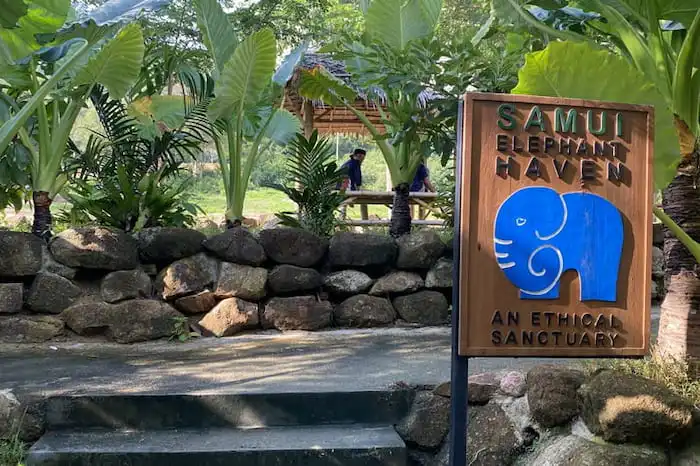
Samui Elephant Haven gives travellers an opportunity to learn about rescued elephants without leaving Koh Samui.
This makes the sanctuary particularly relevant for visitors whose itinerary focuses on the Gulf of Thailand rather than Chiang Mai, Sukhothai, Phuket, or mainland wildlife destinations.
The experience centres on understanding the elephants as individuals. Visitors can learn about their backgrounds, diets, personalities, social relationships, and daily care while gaining a clearer understanding of why rescued elephants may need lifelong support.
Many captive elephants cannot simply be returned to the wild. An elephant may have spent decades depending on people for food, developed lasting health problems, or lost the social group and practical knowledge needed for independent survival.
Sanctuary care must therefore respond to the needs of each elephant rather than follow a fixed recovery timetable.
Best for a Koh Samui Itinerary
Samui Elephant Haven may suit travellers looking for:
- An elephant sanctuary experience on Koh Samui
- Educational information about rescued elephants
- Insight into elephant care and rehabilitation
- An activity that fits naturally into an island holiday
- A responsible alternative to elephant entertainment
- Opportunities to support the elephants’ long-term care
Visitors should review the current programme before booking so they understand which activities are included. During the visit, the elephants’ comfort and daily needs should take priority over photographs or close interaction.
What Makes Boon Lott’s Elephant Sanctuary Distinctive?
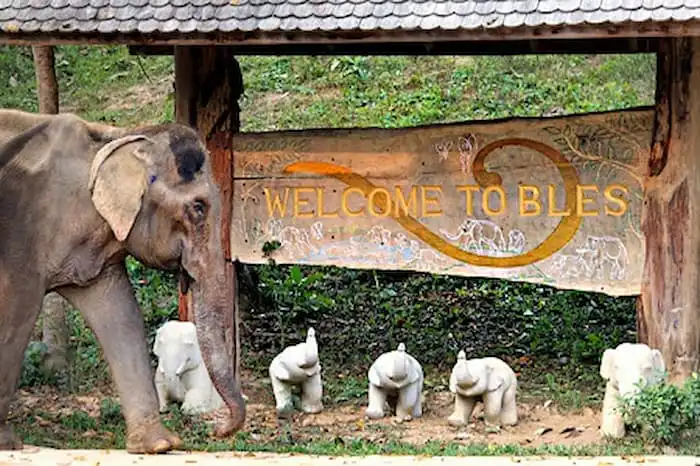
Boon Lott’s Elephant Sanctuary, commonly called BLES, is located in Sukhothai. It is known for providing long-term care in a quieter setting with controlled visitor numbers.
Rather than presenting a high-volume tourist attraction, the sanctuary focuses on the elephants’ daily lives, individual histories, and continuing welfare needs.
Its location outside Thailand’s busiest tourism centres may appeal to visitors who prefer a slower and more personal experience. However, travellers may need to build a separate Sukhothai stop into their itinerary.
Best for a Small-Scale Experience
Boon Lott’s Elephant Sanctuary may appeal to travellers interested in:
- Limited visitor numbers
- A quieter rural environment
- Long-term sanctuary care
- Learning about individual rescued elephants
- An experience away from the main island destinations
Advance planning is advisable because small-scale venues cannot always accommodate last-minute visitors.
Why Consider ChangChill Near Chiang Mai?
ChangChill offers an observation-led elephant experience in the Chiang Mai region.
Visitors observe elephants moving through a natural environment rather than riding, bathing, or directing them through performances. The experience also introduces the relationship between elephant welfare, local livelihoods, caregivers, and community-based tourism.
This is important because changing elephant tourism cannot focus only on visitor activities. It must also consider the people and communities whose incomes have historically depended on captive elephants.
Best for Community-Based Tourism
ChangChill may be suitable for visitors looking for:
- A day trip from Chiang Mai
- Observation rather than physical contact
- A rural and forested environment
- Information about elephant behaviour
- A community-focused tourism model
Travellers should confirm whether they are booking a half-day or full-day programme and review the activities included in the current itinerary.
What Can Travellers Expect at Following Giants?
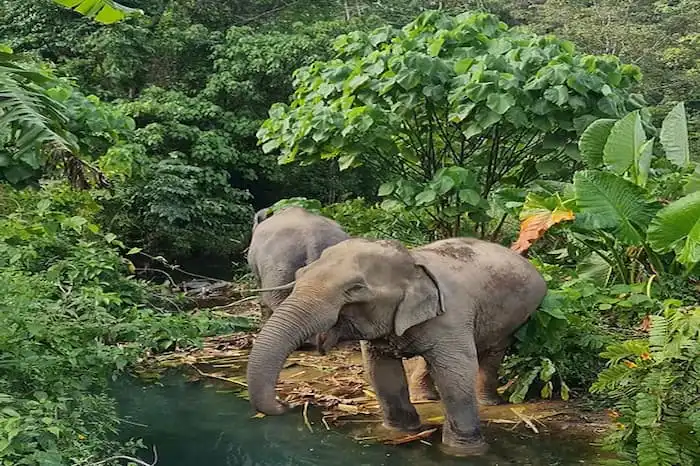
Following Giants operates in southern Thailand, with experiences associated with Koh Lanta and Krabi.
Its observation-focused approach encourages visitors to follow elephants from a respectful distance while the animals walk, forage, dust themselves, and explore the surrounding environment.
The experience is built around watching what elephants choose to do rather than directing them through a tourist schedule.
Best for Southern Thailand
Following Giants may be convenient for travellers staying in:
- Koh Lanta
- Krabi
- Ao Nang
- Nearby southern islands
- Coastal areas of the Andaman region
Because programmes and transport arrangements may differ between locations, travellers should confirm which venue they are booking.
Is Phuket Elephant Sanctuary a Responsible Choice?
Phuket Elephant Sanctuary offers an alternative to elephant riding, shows, and performance-focused attractions on the island.
The sanctuary cares for elephants that have previously worked in tourism or labour. Visitors can learn about their histories while observing them within a forested environment.
This option may be particularly practical for travellers who want to include an elephant experience in a Phuket holiday without adding a domestic flight or long-distance journey.
Best for Visitors Staying in Phuket
The sanctuary may suit travellers seeking:
- An observation-focused programme
- An elephant experience within Phuket
- Information about rescued and retired elephants
- A half-day activity during a beach holiday
- An alternative to riding and shows
Several elephant businesses in Phuket use similar words in their names. Visitors should check the exact operator and official website before making a reservation.
Why Visit Somboon Legacy Foundation in Kanchanaburi?
Somboon Legacy Foundation is located in Kanchanaburi and promotes a hands-off approach to elephant observation and education.
The experience focuses on learning about elephant behaviour, rescue, care, and welfare rather than participating in physical interactions.
Kanchanaburi is accessible from Bangkok, making it useful for travellers who are not visiting Chiang Mai, Koh Samui, or the southern islands.
Best for a Bangkok and Kanchanaburi Trip
A visit may be combined with:
- Kanchanaburi’s historical attractions
- River-based accommodation
- Rural scenery
- National parks in western Thailand
- A wider journey from Bangkok
Visitors should still check journey times carefully because the province covers a large area.
Which Sanctuary Is Best for Your Thailand Itinerary?
The best choice will often depend on where you are already travelling. Selecting a responsible venue near your destination can reduce additional flights, road transfers, and travel time.
| Destination | Sanctuary to consider |
| Koh Samui | Samui Elephant Haven |
| Chiang Mai | ChangChill |
| Sukhothai | Boon Lott’s Elephant Sanctuary |
| Phuket | Phuket Elephant Sanctuary |
| Krabi or Koh Lanta | Following Giants |
| Bangkok or Kanchanaburi | Somboon Legacy Foundation |
Travellers staying on Koh Samui do not necessarily need to travel to northern Thailand to learn about rescued elephants. Visiting Samui Elephant Haven allows them to include an elephant-focused experience within an existing island itinerary.
What Warning Signs Should You Check Before Booking?
A professional website, positive reviews, or the word “rescue” does not prove that a venue provides high welfare standards.
Several warning signs can help visitors identify experiences built primarily around entertainment.
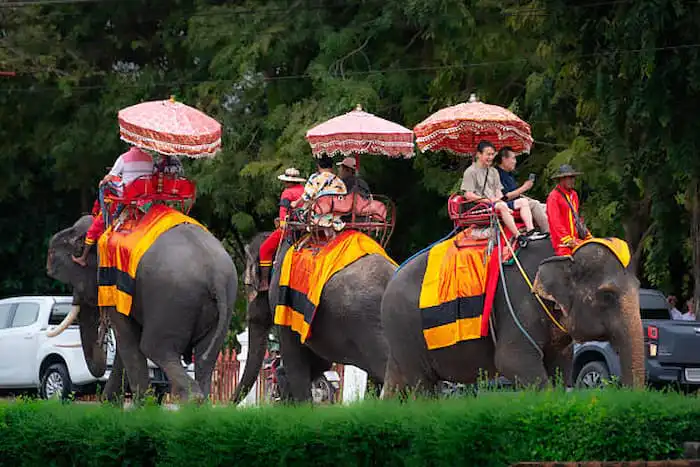
Elephant Riding
Avoid venues offering saddled trekking, bareback riding, or shortened “ethical rides.”
Even when a ride is described as gentle, the elephant must still follow a fixed route and visitor timetable. A responsible sanctuary should not need elephants to carry tourists to fund their care.
Circus-Style Performances
Painting, dancing, playing football, balancing, headstands, and other tricks are not natural elephant behaviours.
These activities require elephants to repeat trained actions for visitors. A venue offering performances is operating as an entertainment attraction, even when it also uses words such as “sanctuary” or “conservation.”
Scheduled Tourist Bathing
Bathing may appear harmless because elephants naturally use water and mud. However, a scheduled tourist-bathing programme is different from watching elephants bathe by choice.
Repeated sessions may require elephants to:
- Enter the water at set times
- Remain beside changing groups of visitors
- Accept touching and splashing
- Stay in position for photographs
- Repeat the activity throughout the day
Observation-led programmes allow elephants to bathe without requiring visitors to enter the water with them.
Forced Touching and Posing
Hugging, kissing, holding an elephant’s trunk, sitting on its legs, or posing beside its face can restrict the animal’s choice and create safety risks.
A responsible experience cannot guarantee close physical contact because the elephant should be free to move away.
Young Elephants Used as Attractions
The presence of a calf does not automatically indicate poor welfare. However, travellers should ask:
- Was the calf born at the venue?
- Does it remain with its mother?
- Is breeding part of the sanctuary’s policy?
- Is the calf used for close-contact photographs?
- Why is such a young elephant participating in tourism?
A calf should not be separated from its mother or presented as a visitor attraction.
Unclear Elephant Histories
Responsible sanctuaries should be transparent about where their elephants came from and why they require care.
Visitors should be cautious when staff cannot explain:
- An elephant’s previous work
- How it arrived at the sanctuary
- Why it cannot return to the wild
- Whether breeding occurs
- What veterinary support is available
- How the elephants are managed outside visitor hours
How Should You Compare Elephant Sanctuaries?
Do not judge a sanctuary through one promise alone. “No riding” is important, but it does not confirm that all other activities are appropriate.
Use the following questions to compare the complete visitor experience.
| Question | Stronger welfare practice | Reason for caution |
| Can elephants move away? | Elephants choose where to walk and rest | They must remain beside visitors |
| Is bathing included? | Visitors observe natural bathing | Tourists enter the water and wash them |
| Are photographs staged? | Photos are taken from a respectful distance | Elephants must pose or accept touching |
| Is feeding offered? | It is limited and carefully supervised | Several groups continuously hand-feed |
| Are elephants ridden? | No riding in any programme | Bareback or “gentle” rides are available |
| Do elephants perform? | No tricks or demonstrations | Painting, dancing, or games are offered |
| Are their histories shared? | Individual backgrounds are explained | The elephants’ origins remain unclear |
| Can visitors ask questions? | Staff explain care and welfare openly | Answers are vague or overly promotional |
Visitors should also examine recent programme information rather than relying only on reviews written several years ago.
Is Feeding Elephants Always Unethical?
Feeding is more complex than riding or performing.
A controlled feeding activity may give visitors an educational opportunity while helping caregivers provide part of an elephant’s daily diet. However, the activity should be carefully managed and should not require elephants to accept continuous touching or remain in one position.
Travellers should consider:
- Whether the elephant can leave the feeding area
- How many groups feed it each day
- Whether the food forms part of an appropriate diet
- Whether a barrier protects both visitors and elephants
- Whether feeding is used to force photographs
- Whether visitors receive clear safety instructions
An activity becomes more concerning when food is used to keep elephants surrounded by tourists throughout the day.
How Can You Prepare for a Responsible Sanctuary Visit?
Your behaviour during a sanctuary visit can also affect elephant welfare.
Follow the caregivers’ instructions, speak quietly, and avoid sudden movement. Never walk behind an elephant, block its path, or approach without permission.
Wear suitable clothing and footwear for outdoor conditions. Forest paths may be muddy, uneven, or slippery, particularly during Thailand’s rainy season.
Visitors should also accept that an elephant may:
- Rest away from the group
- Remain under shade
- Choose not to approach
- Walk out of view
- Avoid other elephants
- Change its routine because of weather or health
These possibilities are signs that the experience is not entirely staged. An ethical programme cannot guarantee that every elephant will perform a particular behaviour for visitors.
How Can Travellers Support Better Elephant Welfare?
Traveller demand influences the types of elephant activities that continue to operate in Thailand.
When tourists stop paying for rides, shows, forced bathing, and staged contact, businesses have a stronger reason to adopt observation-led experiences.
Travellers can support better welfare by:
- Researching the exact venue before booking
- Avoiding riding and performance attractions
- Reading the full programme description
- Asking direct questions about visitor contact
- Booking through the sanctuary’s official channels
- Following welfare-focused visitor rules
- Leaving accurate reviews after the visit
- Supporting transparent rescue and care programmes
- Sharing responsible alternatives with other travellers
Reviews are particularly useful when they describe the actual activities rather than simply stating that the experience was enjoyable.
Conclusion
Choosing among the best ethical elephant sanctuaries in Thailand requires careful research because a sanctuary name alone does not confirm how elephants are treated. We encourage travellers to look for suitable living conditions, transparent care, natural behaviour, and experiences that give elephants the freedom to move away from visitors. At Samui Elephant Haven, we help visitors learn about rescued elephants while supporting their long-term care on Koh Samui. Travellers searching for the best elephant sanctuary in Koh Samui should look beyond close-contact attractions and choose an experience that places elephant welfare before entertainment.
FAQ
What Is the Most Ethical Elephant Sanctuary in Thailand?
There is no permanent official ranking of one venue as Thailand’s most ethical sanctuary. Practices may change, so visitors should evaluate current activities, elephant living conditions, transparency, and the amount of choice given to the animals.
Is Samui Elephant Haven an Ethical Elephant Sanctuary?
Samui Elephant Haven focuses on rescued elephants, education, and long-term care. Visitors should review its current programmes directly before booking so they understand the activities, welfare approach, and visitor guidelines.
Are All Elephant Sanctuaries in Thailand Ethical?
No. Some facilities use sanctuary or rescue language while continuing to offer riding, performances, scheduled bathing, or intensive physical contact. The name alone is not sufficient evidence of responsible welfare practices.
Is It Ethical to Ride an Elephant in Thailand?
Responsible elephant sanctuaries do not offer saddled rides, bareback riding, or trekking. Observation-led programmes allow visitors to learn about elephants without requiring them to carry people.
Is Bathing With Elephants Ethical?
Scheduled tourist bathing may restrict an elephant’s choice by requiring it to enter the water, remain beside visitors, and accept repeated touching. Watching elephants bathe naturally from a suitable distance is the more welfare-focused option.
Is Feeding Elephants Ethical?
Limited and supervised feeding may be acceptable when it forms part of an appropriate diet and does not require constant contact. Visitors should avoid experiences in which elephants are surrounded and continuously hand-fed by large groups.
Which Elephant Sanctuary Is Best for Koh Samui?
Samui Elephant Haven is a convenient choice for travellers who want to learn about rescued elephants while staying on Koh Samui. Visitors should check the current programme before booking.
Which Area of Thailand Has the Best Elephant Sanctuaries?
Responsible elephant venues can be found in several regions, including Koh Samui, Chiang Mai, Sukhothai, Phuket, Krabi, Koh Lanta, and Kanchanaburi. The venue’s welfare practices matter more than its location.
Can Rescued Elephants Be Released Into the Wild?
Not every rescued elephant can return to the wild. Some have lived under human care for decades, have ongoing health conditions, lack survival skills, or cannot join a suitable wild population. These elephants may require specialised lifelong care.
How Can I Check an Elephant Sanctuary Before Visiting?
Review its official programme, ask whether it offers riding, bathing, shows, touching, or breeding, and look for transparent information about the elephants’ histories, living conditions, veterinary care, and activities outside visitor hours.
