
A day at an ethical elephant sanctuary in Thailand should feel very different from a conventional animal attraction. The purpose is not to keep elephants performing for visitors from morning until evening. Instead, the experience should give guests an opportunity to learn while allowing elephants time and space to eat, roam, rest, socialise, and make their own choices.
That distinction matters in 2026. World Animal Protection’s latest assessment reviewed 236 elephant tourism venues in Thailand housing 2,849 elephants and found that only 7% of elephants were involved in higher-welfare, observation-only experiences. The organisation recommends venues that reduce direct contact and give elephants greater opportunities to express natural behaviours.
So, what does a responsible sanctuary day actually look like? There is no universal timetable. Every elephant, sanctuary, season, and visitor programme is different. However, the daily rhythm usually revolves around food, movement, rest, social interaction, enrichment, and appropriate care rather than rides, shows, or repeated performances.
What Happens in the Morning at an Elephant Sanctuary?
Morning is often one of the most active periods for Asian elephants because temperatures are cooler and feeding naturally occupies a large part of their day.
According to the Smithsonian’s National Zoo, Asian elephants spend roughly three-quarters of each day eating or travelling towards food and water, with major feeding periods occurring in the morning, afternoon, and at night. Wild elephants can consume approximately 74 to 150 kg of food each day, depending on their size and circumstances.
At a responsibly managed sanctuary, caregivers may begin their day by checking the elephants, preparing food, inspecting facilities, and observing each animal for changes in behaviour or physical condition.
Visitors usually arrive later, depending on the programme. Their first experience should include an introduction to the sanctuary, elephant welfare, and safety before they approach areas where elephants are present.
The Day Starts With Observation, Not Entertainment
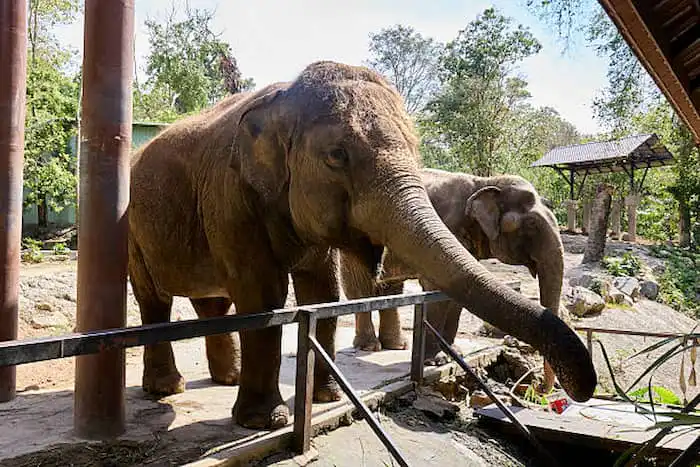
Visitors should not expect elephants to be lined up waiting for a tour group.
One elephant may already be eating. Another may be resting under shade, interacting with another elephant, or moving through a different area.
That unpredictability is important.
When elephants have genuine choice, a visitor cannot expect the same behaviour at the same point during every tour. A responsible sanctuary allows the animals’ needs to influence the experience rather than forcing them into a fixed performance schedule.
What Does an Ethical Elephant Sanctuary Actually Mean?
The word “sanctuary” alone does not guarantee high welfare.
World Animal Protection advises travellers to look for venues where elephants can move freely, forage, socialise, and avoid forced tourist interactions. Its current guidance specifically recommends observation rather than riding, bathing, touching, or other close-contact experiences.
A stronger welfare model generally avoids:
- Elephant riding
- Tricks and performances
- Forced posing
- Scheduled tourist bathing
- Continuous physical contact
- Activities requiring elephants to remain beside visitors
The objective is not to recreate the wild perfectly. Many rescued captive elephants cannot simply be released. Instead, responsible sanctuary management aims to provide suitable lifelong care while allowing as much natural behaviour and autonomy as circumstances permit.
Why Does Feeding Take Up So Much of an Elephant’s Day?
Eating is not simply a scheduled breakfast or dinner activity for elephants.
Their digestive system is relatively inefficient, so they need to consume large quantities of vegetation. The Smithsonian reports that Asian elephants naturally eat grasses along with leaves, vines, roots, bark, shoots, and fruit. An Adult Asian elephants needs to consume 150 to 200 kilograms(330 to 440 pounds) of food daily, amounting to 5% to 10% of their total body weight.
This means food can also provide behavioural enrichment.
Rather than placing every meal in one pile, caregivers may distribute suitable vegetation around an elephant’s environment so that the animal has to move, search, pull, manipulate, and forage.
This encourages behaviour closer to the way elephants naturally spend their time.
| Feeding approach | Why it matters |
| Browse and grasses | Encourages chewing and natural feeding behaviour |
| Food distributed across an area | Encourages walking and searching |
| Suitable branches or vegetation | Allows elephants to manipulate food with their trunks |
| Individually managed diets | Helps account for age, health, weight, and dental condition |
| Controlled supplementary feeding | Allows caregivers to monitor intake where needed |
Fruit can form part of managed feeding, but it should not replace a varied, appropriate diet simply because tourists enjoy feeding bananas or watermelon.
What Can Visitors Learn During Elephant Feeding?
Some sanctuaries offer supervised feeding, while the highest-welfare observation-only models may minimise or avoid direct visitor feeding altogether.
Where feeding is offered, it should be managed around the elephant rather than used as a way to keep the animal permanently positioned for tourists.
Watching an elephant eat provides an opportunity to observe how sophisticated its trunk is. The trunk can smell, investigate, grasp, lift, separate, and position food with extraordinary precision.
Visitors may also notice individual preferences. One elephant may favour particular vegetation, while another eats differently because of age, dental condition, health, or previous experiences.
The educational value should come from understanding these differences rather than trying to obtain the closest photograph possible.
What Happens During a Sanctuary Walk?
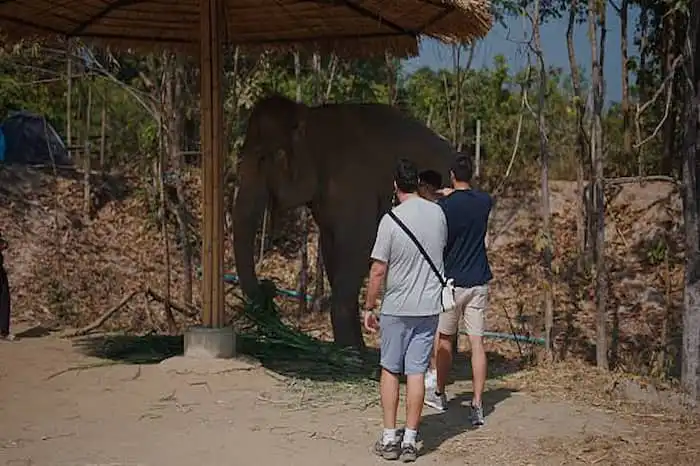
Walking through an elephant sanctuary in Thailand should usually mean moving through the elephants’ environment rather than making the elephants walk a set route for tourists.
Depending on the sanctuary, visitors might follow designated trails, use viewing areas, or observe elephants from a suitable distance while guides explain what they are doing.
You may see an elephant:
- Pull vegetation from a tree
- Investigate the ground with its trunk
- Walk towards another elephant
- Seek shade
- Dust its body
- Stop to feed
- Move away from the visitor group
None of these behaviours may seem as dramatic as a performance. That is precisely the point.
A sanctuary experience should help visitors appreciate ordinary elephant behaviour instead of requiring an animal to do something unusual for entertainment.
Why Are Social Relationships Important for Elephants?
Elephants are highly social animals, particularly females, which naturally form complex family groups.
Relationships can influence how elephants move, rest, communicate, and respond to unfamiliar situations. However, rescued elephants do not necessarily arrive at a sanctuary as a naturally formed family herd.
Some may have spent years separated from other elephants. Others may have developed particular behavioural or health needs because of previous working conditions.
Responsible sanctuaries therefore cannot simply place every rescued elephant together and assume they will form a herd.
Social introductions require observation and individual management. Compatible elephants may develop close relationships, while others may prefer more space.
A good sanctuary respects those differences rather than forcing social interaction for visitors.
What Do Elephants Do During the Hottest Part of the Day?
The middle of the day is often quieter.
Elephants may spend time resting, feeding in shaded areas, moving towards water, or reducing their activity during high temperatures.
The Smithsonian notes that Asian elephants commonly rest and nap during the hottest hours of the day.
Visitors should therefore not interpret a resting elephant as an animal that needs entertainment.
Quiet periods are part of normal sanctuary life.
A responsible visitor programme should be able to explain why an elephant is resting instead of attempting to make it stand, approach, or perform simply because guests have arrived.
Why Are Mud, Dust, Water, and Shade Important?
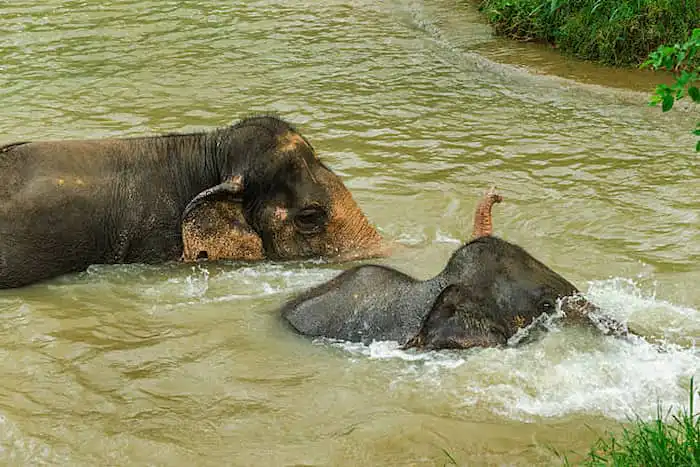
Elephants use their environment to help regulate their bodies and care for their skin.
Shade becomes particularly valuable during hot weather. Water may be used for drinking and bathing, while mud and dust can coat the skin and provide protection from sun and insects.
What matters from an animal-welfare perspective is who controls the activity.
An elephant choosing to enter a pool is different from an elephant being directed into water several times a day so successive tour groups can bathe it.
World Animal Protection’s current elephant-tourism guidance advises travellers to avoid venues offering bathing or touching and instead select experiences centred on observation.
Natural Bathing Is Different From Tourist Bathing
This distinction is easy to miss.
Seeing an elephant cover itself with mud, spray water with its trunk, or enter a pool naturally can be fascinating. Visitors do not need to be standing beside the animal for the experience to be meaningful.
In fact, observation often reveals more about elephant behaviour because the animal is making the decisions.
What Happens During the Afternoon?
As temperatures change, elephants may become more active again.
Afternoon routines can include further feeding, walking, enrichment, social activity, health checks, or simply time spent in another part of the sanctuary.
There should not be one mandatory sequence.
A healthy sanctuary routine needs enough flexibility for caregivers to respond to:
- Weather
- Individual health
- Elephant relationships
- Food requirements
- Veterinary advice
- Seasonal conditions
- The elephant’s behaviour that day
A visitor may therefore see something completely different from someone who attended the previous morning.
That variability is more consistent with an animal-centred experience than guaranteeing the same photograph, bath, walk, or interaction during every session.
How Is an Ethical Sanctuary Different From an Elephant Attraction?
The clearest difference is the purpose of the experience.
An entertainment attraction needs the elephant to produce something for the visitor. A welfare-focused sanctuary should instead help the visitor understand what the elephant chooses to do.
| Factor | Stronger sanctuary practice | Reason for concern |
| Riding | Not offered | Saddled or bareback rides |
| Performances | No tricks or shows | Painting, dancing, games, or staged behaviours |
| Bathing | Elephants use water by choice | Scheduled tourist bathing |
| Visitor interaction | Observation is prioritised | Constant touching and posing |
| Feeding | Managed around elephant needs | Elephants continuously fed by tour groups |
| Movement | Elephants can choose where to go | Fixed routes or performance areas |
| Rest | Resting elephants are left undisturbed | Elephants encouraged to stand or interact |
| Education | Welfare and behaviour are explained | Experience centres primarily on photos |
World Animal Protection’s 2026 research found that 42% of elephants assessed in Thai tourism venues were still being used for rides, while more than half were observed on short chains during the day. These findings show why travellers should investigate individual venues instead of assuming that every place using the term sanctuary follows the same standards.
How Should You Choose an Ethical Elephant Sanctuary?
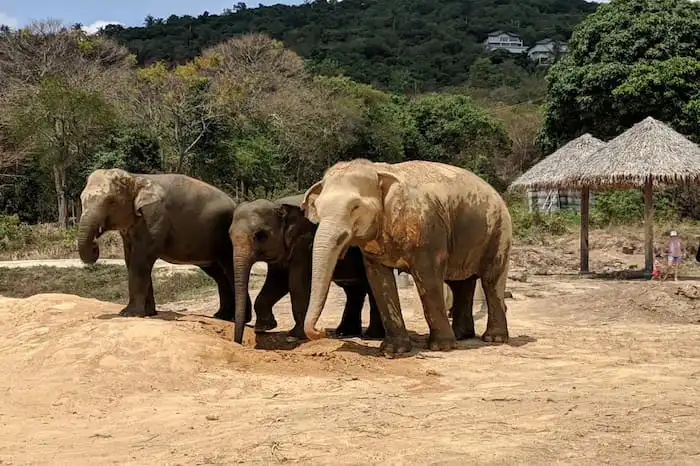
Start by examining the activities offered on the venue’s own website.
World Animal Protection recommends observation-led venues and warns travellers that names such as “sanctuary,” “rescue centre,” and “retirement home” do not prove that a facility meets good welfare standards.
Before booking, ask:
- Does the venue offer riding?
- Can tourists bathe or constantly touch elephants?
- Are there shows or tricks?
- Can elephants move away from visitors?
- Does the sanctuary explain individual rescue histories?
- What happens outside visitor hours?
- Does it breed elephants for tourism?
- Does the programme focus on education or interaction?
Pay particular attention to experiences described as “ethical bathing,” “ethical touching,” or other close-contact alternatives. The terminology may have changed while the underlying visitor activity remains highly controlled.
Our guide to choosing an ethical elephant sanctuary in Thailand provides additional criteria for comparing venues before you book.
What Should You Wear and Bring for a Sanctuary Visit?
An elephant sanctuary visit is usually an outdoor activity, so practical clothing is more useful than dressing for photographs.
Consider bringing:
- Lightweight, breathable clothing
- Comfortable walking shoes
- A hat
- Sunscreen
- Insect repellent
- Rain protection when appropriate
- Drinking water if the sanctuary does not provide it
- A phone or camera
Avoid approaching an elephant simply to improve a photograph.
Our guide to ethical elephant photography explains how distance, quiet movement, and avoiding staged interactions can produce more responsible wildlife images.
Should Visitors Expect to Bathe Elephants?
No. Bathing should not be treated as a necessary part of an ethical sanctuary visit.
For years, tourist bathing was promoted as a compassionate alternative to riding. Welfare guidance has continued to evolve, however, and organisations including World Animal Protection now recommend observation-only experiences without direct touching or washing.
An elephant can still use pools, mud, and water naturally. The difference is that visitors watch rather than joining the animal in the water.
Readers planning an elephant experience can learn more in our guide explaining why ethical sanctuaries do not offer elephant bathing.
How Long Does an Elephant Sanctuary Visit Take?
There is no standard duration across Thailand.
Some venues offer short educational visits, while others provide half-day or full-day programmes and even overnight stays at their accommodations. Volunteer experiences can last considerably longer.
The important question is not whether the visit lasts three hours or eight. It is whether the programme uses that time responsibly.
A longer experience is not automatically more ethical, particularly if additional hours simply mean more feeding, touching, bathing, or staged interaction.
Likewise, a shorter programme can still contribute to elephant care when visitor numbers, activities, and welfare are appropriately managed.
What Is the Best Time of Year to Visit an Elephant Sanctuary in Thailand?
Thailand can be visited throughout the year, but conditions vary considerably by region.
The cooler months generally make walking outdoors more comfortable. Hot-season visits can involve high temperatures, while the rainy season may bring muddy trails and sudden downpours.
However, nationwide dates should not be treated as universal because rainfall patterns differ between northern Thailand, the Andaman coast, and Gulf islands such as Koh Samui.
Check local weather conditions and the sanctuary’s advice shortly before your visit.
Elephant behaviour may also change with temperature, rainfall, and available shade, so visitors should remain flexible about what they expect to see.
What Does a Full-Day Volunteer Experience Involve?
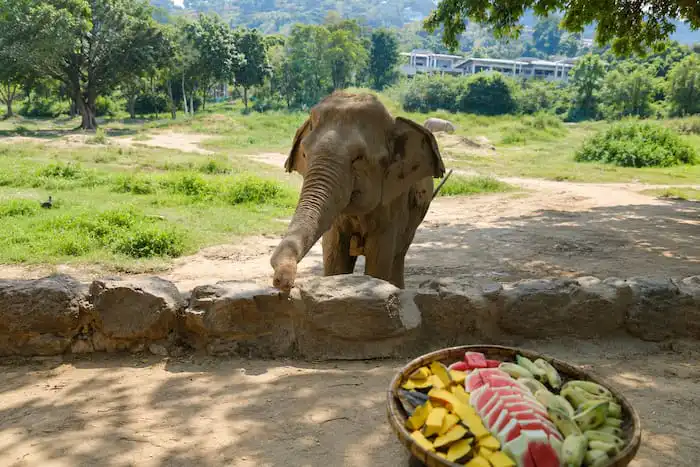
Some sanctuaries offer volunteer programmes that provide a closer look at the work required behind the scenes.
Activities might include preparing food, cleaning designated areas, maintaining the grounds, planting vegetation, or helping with enrichment tasks.
The important distinction is that volunteering should contribute to care rather than create additional forced interaction with elephants.
At Samui Elephant Haven, for example, the current one-day volunteer programme runs from 9:00 a.m. to 5:00 p.m. and includes food preparation, cleaning designated areas, preparing rice balls, walking through the park, learning the elephants’ histories, and optional planting or enrichment activities. The published programme does not include riding or bathing.
What Should You Expect From an Elephant Sanctuary Day?
The best sanctuary days are often less predictable than visitors expect.
You might watch an elephant eat for longer than anticipated. One may walk away while another remains nearby. You may spend part of the visit listening to a guide explain an elephant’s rescue history rather than interacting with the animal itself.
That is not a lesser experience.
It reflects a fundamental change in responsible elephant tourism: visitors adapt to elephants instead of requiring elephants to adapt to visitors.
At a genuine welfare-focused sanctuary, the highlight is not receiving a guaranteed close-up interaction. It is seeing an elephant make its own decisions.
Conclusion
A day at an ethical elephant sanctuary is ultimately about learning to appreciate elephants without asking them to entertain us. At Samui Elephant Haven, our rescued elephants live across a 60-rai sanctuary on Koh Samui, while our visitor programmes focus on elephant education, supervised care activities, guided observation, and learning about each elephant’s individual history. If you are looking for an ethical elephant sanctuary in Thailand, we encourage you to choose experiences where welfare, natural behaviour, and respect for the elephants remain at the centre of the day.
FAQ
What Do Elephants Do All Day at a Sanctuary?
Their days generally revolve around eating, foraging, walking, resting, social activity, enrichment, water or mud use, and individual care. There is no single timetable that applies to every elephant or sanctuary.
What Should I Wear to an Elephant Sanctuary in Thailand?
Wear lightweight, breathable clothing and comfortable footwear suitable for outdoor paths. Sun protection, insect repellent, and rain protection may also be useful depending on the weather.
Can You Ride Elephants at an Ethical Sanctuary?
A welfare-focused elephant sanctuary should not offer elephant riding. Current World Animal Protection guidance recommends observation-led experiences where elephants are not required to carry, perform for, bathe with, or accept touching from visitors.
Is Bathing With Elephants Ethical?
Current best-practice tourism guidance recommends watching rather than joining elephants in the water. Elephants may still bathe naturally, but scheduled tourist bathing can require close control and repeated interaction.
How Much Do Elephants Eat Each Day?
The Smithsonian reports that Asian elephants in the wild can consume approximately 74 to 150 kg of food per day, with very large males potentially eating more.
Do Ethical Elephant Sanctuaries Allow Feeding?
Practices differ. Some higher-welfare venues offer supervised feeding, while observation-only sanctuaries minimise or eliminate direct contact. Feeding should be managed around the elephant’s nutritional and behavioural needs rather than continuous tourist interaction.
How Long Should I Spend at an Elephant Sanctuary?
Programmes range from less than an hour to full-day experiences. Duration is less important than the quality of the programme, the welfare standards, and how much choice the elephants retain.
Do Elephants Follow the Same Routine Every Day?
Not necessarily. Weather, health, social relationships, diet, veterinary needs, and individual behaviour can all affect the day. A sanctuary should have enough flexibility to respond to the elephants rather than forcing them into an identical visitor schedule.
Is Samui Elephant Haven a Full-Day Experience?
Samui Elephant Haven currently offers different programmes. Its standard sanctuary tours last three hours, while its one-day volunteer programme runs from 9:00 a.m. to 5:00 p.m. Programme details can change, so visitors should confirm the latest schedule before booking.
