
Asian elephants are listed as Endangered on the IUCN Red List, with fewer than 50,000 estimated to remain in the wild. In Thailand, the Department of National Parks estimated 4,013–4,422 wild elephants in its recent reporting, while a 2026 World Animal Protection assessment documented 2,849 elephants across 236 tourism venues.
That makes the role of elephant sanctuaries in conservation more complex than simply “rescuing elephants.” Sanctuaries do not replace protected forests, wildlife corridors, anti-poaching work, or human-elephant conflict management. Their strongest contribution is caring for elephants that cannot simply be returned to the wild while helping change the tourism and economic systems that shaped captivity in the first place.
A responsible sanctuary can contribute in five connected ways: habitat and land stewardship, rescue and rehabilitation, veterinary care, economic transition, and visitor education. Koh Samui offers a useful lens because its elephant history developed around island tourism, not only the northern trekking industry that dominates most discussions.
From Working Elephant to Sanctuary: Why Thailand’s History Matters
Thailand’s captive-elephant economy changed sharply after the national logging ban introduced in 1989. Research on elephant tourism describes how the ban left many working elephants and mahouts without their former livelihoods, accelerating a shift into trekking, shows, street begging, and other tourism activities.
Most elephants in Thai sanctuaries today are therefore not wild animals being prepared for release. Many have spent years or decades in logging or tourism and need long-term human care. For them, conservation is closely tied to welfare: ending harmful work, improving health, encouraging more natural behaviour, rebuilding social contact, and creating an economic model that can support lifelong care.
The Five Conservation Roles of a Responsible Elephant Sanctuary
1. Habitat and land stewardship
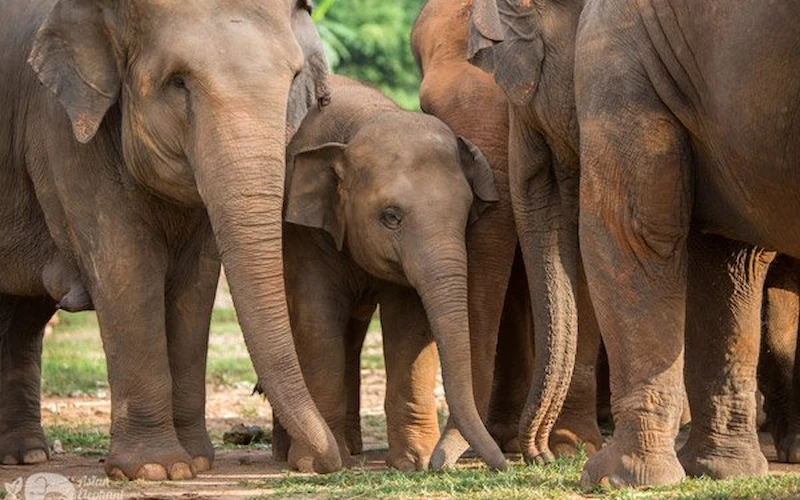
Elephants need space to move, forage, rest, socialise, seek shade, and use water and mud on their own terms. A sanctuary can provide that space for captive elephants while protecting land from more intensive development.
A sanctuary enclosure is not automatically a wildlife corridor, however, and caring for captive elephants is not the same as conserving a wild population. The conservation value is stronger when land is protected over the long term or linked to wider habitat work. As one benchmark, Boon Lott’s Elephant Sanctuary reports protecting more than 600 acres of forest over two decades while rescuing 48 elephants.
2. Rescue and rehabilitation
Rescue is only the beginning. Former logging, trekking, street-begging, or entertainment elephants may need treatment for old injuries, poor foot condition, nutritional problems, limited mobility, or long-term stress.
Rehabilitation combines appropriate food, veterinary attention, social opportunities, space, predictable routines, and time. Samui Elephant Haven’s guide to how rescued elephants heal explores this process in more detail, including medical care, behavioural recovery, and rebuilding herd relationships.
3. Veterinary care and practical knowledge
Long-lived captive elephants require specialised care for feet, joints, teeth, nutrition, wounds, infectious disease, and age-related conditions. Good sanctuaries keep individual health histories, work with veterinary professionals, and adapt care as elephants age.
Samui Elephant Haven has also documented the loss of the young elephant Luna to elephant endotheliotropic herpesvirus (EEHV), showing why monitoring and specialised veterinary care matter. Readers can explore the care side further in the sanctuary’s guide to elephant health & wellness.
4. Economic transition for mahouts and communities
A less visible role is changing the economics around elephant work. When riding, shows, or logging provide income, simply telling owners and mahouts to stop does not solve the underlying problem.
A responsible sanctuary model can create alternative work in elephant care, guiding, food preparation, land maintenance, education, and sanctuary operations. This is where elephant sanctuary conservation becomes more than individual rescue: better welfare needs an economic model that can sustain it.
5. Visitor education and changing demand
Tourist demand helped shape elephant entertainment, which means visitor choices can also help change it. A sanctuary visit should explain natural elephant behaviour, why riding and performances are problematic, and why captive-elephant welfare differs from wild-elephant conservation.
World Animal Protection’s 2026 assessment found that riding has declined substantially since 2010, while close-contact activities such as washing and hand-feeding have become more common and are often marketed as ethical alternatives. The question is therefore no longer only “Does this place offer riding?” Visitors also need to ask how much choice the elephants have and whether their day is organised around natural behaviour or repeated tourist interaction.
Together, the five roles explain how sanctuaries protect elephants through long-term care, land, knowledge, livelihoods, and changing demand.
How Can You Tell an Ethical Elephant Sanctuary from One in Name Only?
The label “sanctuary” is not proof of high welfare. Thailand now has licensing and welfare standards for elephant camps, but travellers still need to examine what actually happens on site.
Use this 60-second check:
| Check | What to look for |
|---|---|
| Riding and performances | No riding, tricks, painting, staged shows, or entertainment routines. |
| Bathing and close contact | No forced bathing or repeated touching sessions; observation-led experiences give elephants more control. |
| Choice | Elephants should be able to move away from visitors rather than being held in place for photos. |
| Natural behaviour | Look for foraging, walking, resting, socialising, dusting, and bathing on the elephants’ own schedule. |
| Space and care | Ask about shade, water, social grouping, veterinary care, and restraint. |
| Transparency | The venue should explain where its elephants came from and what visitor revenue supports. |
| Feeding | Tourist feeding should not replace natural foraging or require elephants to remain available all day. |
Welfare organisations increasingly favour observation-only models with little or no direct visitor contact. That does not make every venue offering limited feeding equivalent to a riding camp, but it does mean the full management system matters more than any single marketing claim. Samui Elephant Haven’s guide to why ethical sanctuaries matter looks more closely at visitor choices and welfare.
Why Island Sanctuaries Matter: The Koh Samui Story
Most discussions of elephant tourism in Thailand still concentrate on Chiang Mai and the north. Koh Samui has a different history, shaped by island tourism.
Samui Elephant Haven’s herd records preserve part of that history. Plai Bank, for example, was separated from his mother at two years old and later walked up and down a beach outside a hotel, stopping for photographs and food. Other elephants at the sanctuary came from logging or trekking backgrounds.
Today, Samui Elephant Haven states that it cares for 14 rescued elephants on 60 rai, more than 23 acres, of hilly and forested land in northern Koh Samui. Its published visitor programme states no riding, no bathing, and no entertainment; tours include education, walking through the park, and feeding fruit, grass, and prepared rice balls.
The island case shows what a tourism-to-sanctuary transition can look like. A sanctuary cannot recreate the wild on Koh Samui, but tourism income can be redirected away from riding, performances, and beach-photo work toward long-term care, healthier routines, and education.
Where Does Reliable Elephant Conservation Data Come From?
Responsible elephant conservation efforts should be grounded in more than sanctuary marketing. The IUCN Red List tracks conservation status; Thailand’s Department of National Parks monitors wild elephants and protected areas; the Department of Livestock Development oversees domesticated-elephant registration and camp standards; and veterinary researchers and welfare organizations assess health and tourism practices.
For the wider Asian-elephant picture, our article on Asia’s vanishing elephants looks more closely at habitat loss, fragmentation, human-elephant conflict, and population pressure. Readers comparing conservation pressures across species can also explore our guide to habitat threats & conservation for African elephants, while keeping in mind that the species and management contexts are different.
What Can Travelers Do?
If you plan to visit an elephant sanctuary in Koh Samui or elsewhere in Thailand, look beyond the label. Choose operators that are transparent about their elephants’ histories and daily management. Avoid riding, shows, forced bathing, and staged performances. Pay attention to space, social contact, natural behaviour, and whether elephants can move away from visitors.
If you cannot visit, responsible donation or adoption programmes can help support food, veterinary care, and long-term management. The goal is not the closest possible elephant photo, but a model in which elephants are valued for their welfare rather than the work they can perform.
Conclusion
At Samui Elephant Haven, we see the role of sanctuaries in conservation as part of a wider responsibility: providing rescued elephants with appropriate lifelong care while helping tourism move away from riding, performances, and other practices that prioritise visitor demand over elephant welfare.
For travellers researching elephant sanctuary Samui experiences, conservation should mean more than simply visiting rescued elephants. A responsible sanctuary should support natural behaviour, appropriate veterinary care, education, and long-term welfare while helping visitors understand how their choices can contribute to more responsible elephant tourism.
FAQ
Are elephant sanctuaries actually good for conservation?
They can contribute, depending on how they operate. High-welfare sanctuaries can support rescued elephants through lifelong care, rehabilitation, veterinary management, education, and economic alternatives to exploitative tourism. They do not replace wild-habitat protection or human-elephant conflict programmes.
What is the role of a sanctuary in elephant conservation?
For captive elephants, the main role is safe long-term care while reducing harmful work and encouraging more natural behaviour. Responsible sanctuaries can also support veterinary knowledge, local livelihoods, public education, and changes in tourism demand.
How do sanctuaries help rescued logging elephants?
They can provide rest, veterinary treatment, appropriate nutrition, social contact, and environments that allow more natural movement and foraging, particularly for elephants with chronic foot, joint, mobility, or injury problems.
How can I tell an ethical elephant sanctuary from a fake one?
Look beyond the name. Avoid rides, tricks, performances, and forced bathing. Check for space, social contact, natural foraging opportunities, veterinary care, transparency about elephant origins, and the ability for elephants to move away from visitors.
What is the biggest elephant sanctuary in the world?
“Biggest” can mean land area, number of elephants, or another measure, so there is no single useful answer without defining the metric. Size also does not prove high welfare. Management, elephant autonomy, veterinary care, transparency, and long-term responsibility are more meaningful criteria.
